

Explore the latest ImmPulse Weekly for key Canadian immigration insights—or browse past editions to catch up.
Alberta Premier Danielle Smith has announced a referendum for October 19, 2026, featuring nine questions aimed at reducing immigration levels and strengthening Alberta’s autonomy within Canada. Rather than addressing separatism, the ballot proposes prioritizing economic migration and restricting access to provincially funded social services, such as healthcare and education, to citizens, permanent residents, and those with approved provincial status. Other questions involve charging fees to non-permanent immigrants for social services, requiring a one-year residency before they can access supports, and seeking constitutional changes to allow provinces to appoint judges and abolish the Senate. Smith positioned this move as a response to plunging oil prices and the “unprecedented strain” on infrastructure and services she attributes to federal “open border” policies.
Attracting the world’s best talent to fill Canada’s labour gaps and build our economy
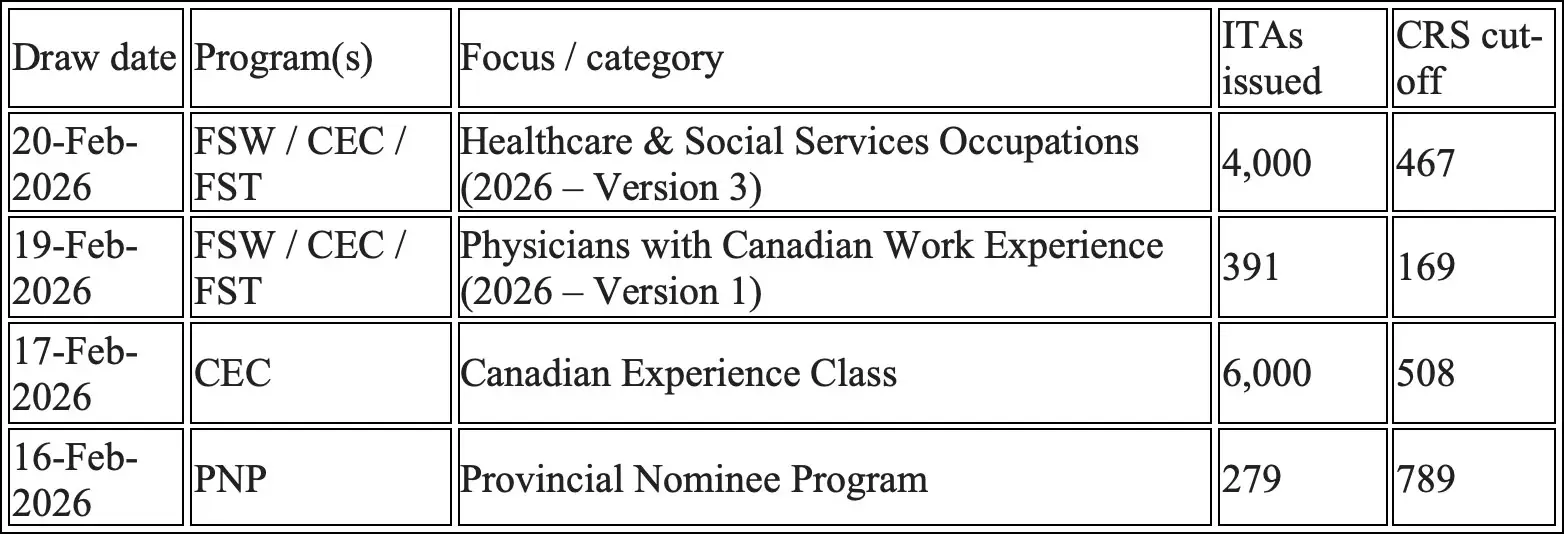
Canada’s International Talent Attraction Strategy utilizes the Express Entry system to fill critical labor gaps in priority industries by inviting skilled workers from the Canadian Experience Class, Federal Skilled Worker Program, and Federal Skilled Trades Program. For 2026, the government introduced new category-based selection groups, including medical doctors, researchers, and senior managers with Canadian work experience, alongside transport occupations and skilled military recruits with job offers from the Canadian Armed Forces. Renewed categories for 2026 continue to prioritize French-language proficiency, healthcare and social services, education, STEM, and trade occupations; however, the minimum work experience requirement for these renewed categories has increased from six months to one year of experience gained within the previous three years. These targeted rounds are designed to respond to long-term labor market shortages and drive growth in innovative sectors while remaining within the overall targets of the 2026–2028 Immigration Levels Plan.
(Source)
Effective January 1, 2026, the Government of Canada introduced Ministerial Instructions 90 (MI90) to update previous protocols and manage the high volume of applications within the Start-up Visa (SUV) and Self-Employed Persons programs. These instructions implement a pause on most new SUV applications, with exceptions only for candidates who received a valid commitment from a designated organization in 2025, while also prioritizing the processing of applicants already in Canada on an SUV-linked work permit. Furthermore, MI90 extends the existing suspension on accepting new permanent residence applications for the Self-Employed Persons Program. These measures are intended to address current application inventories and will remain in effect until further notice.
(Source)
The Canadian government is actively working to manage migration sustainably by reducing the temporary resident population to less than 5% of the total population to alleviate pressures on housing, services, and infrastructure. This strategy led to a significant 53% decline in the total number of new student and worker arrivals in 2025 compared to 2024. Specifically, new student arrivals dropped by 61% following the implementation of study permit caps and stricter application reviews, while new worker arrivals decreased by 47% due to reforms in the Temporary Foreign Worker and Post-Graduation Work Permit programs. Despite these intake reductions, the government is prioritizing the transition of well-integrated temporary residents to permanent status to support long-term economic growth; in 2025, over 188,000 former temporary residents became permanent residents, accounting for approximately 48% of all new permanent residency approvals.
(Source)
To facilitate the successful co-hosting of the 2026 FIFA Men’s World Cup, Canada has implemented a temporary public policy exempting approximately 7,000 “FIFA-invited applicants” from the standard biometric collection requirement. This exemption, effective from November 25, 2025, to July 20, 2026, applies to foreign nationals who hold an official FIFA Letter of Invitation and have applied for a temporary resident visa during this period, provided they have no adverse security or criminal information. The policy also covers diplomats and government officials traveling on official passports who meet these same conditions. By simplifying processing for these essential delegates, the government aims to support a tournament expected to generate $3.8 billion in economic output and create 24,000 jobs across Canada.
(Source)
On February 19, 2026, Immigration, Refugees and Citizenship Canada (IRCC) updated its operational instructions to clarify specific exemptions and requirements for those seeking to study in Canada. These updates provide clear guidance on which individuals are permitted to engage in short-term studies of less than six months and the exact timeframes during which this is allowed. Additionally, the instructions include minor wording refinements regarding study permit requirements for family members of foreign representatives. These procedural updates serve as a resource for IRCC staff to ensure consistent policy application and are shared publicly for the benefit of stakeholders.
(Source)
On February 20, 2026, Immigration, Refugees and Citizenship Canada (IRCC) updated the operational instructions for officers processing foreign nationals under the reciprocal employment general guidelines. This update includes a formal title change to “Reciprocal employment general guidelines [R205(b) – C20] – Canadian interests – International Mobility Program” and standardizes the page to match the program’s preferred formatting. Key structural changes involve removing the Port of Entry (POE) banner to incorporate that information directly into the body of the text, alongside the addition of a new section specifically for family members. Furthermore, the updated instructions provide more robust guidance for the review, approval, and refusal of applications to ensure consistent processing by IRCC staff.
(Source)
On February 19, 2026, the British Columbia government introduced the Post-secondary International Education (Designated Institutions) Act to codify the existing Education Quality Assurance (EQA) program into law. This new legal framework provides the Ministry of Post-Secondary Education and Future Skills with enhanced tools to inspect institutions and take enforcement action against “bad actors” to protect international students from fraud and potential loss of legal status. Under the proposed legislation, only designated institutions meeting high-quality standards are permitted to advertise to, enroll, or deliver programs to international students requiring a study permit. These measures aim to uphold B.C.’s global reputation as a premier education destination by ensuring institutions demonstrate a genuine commitment to quality education and accountability.
(Source)
The Government of the Northwest Territories (GNWT) has announced that the Northwest Territories (NWT) Nominee Program will open its Employer-Driven and Francophone streams on March 9, 2026, with a total allocation of 197 nominations from the federal government. A major update for 2026 is the introduction of a points-based Expression of Interest (EOI) system for the Employer-Driven Stream, designed to prioritize candidates based on factors such as work experience, education, and local labor market needs. Under this new system, only the highest-ranked candidates invited through scheduled draws, starting March 25, 2026, will be eligible to submit a full application, which will then be assessed in the order received. Meanwhile, the Francophone and Business streams will remain separate and continue to operate on a first-come, first-served basis. This transition to an EOI model aims to make the program more transparent and ensure it effectively manages high demand by selecting newcomers most likely to settle and contribute to the NWT long-term.
(Source)
Issue: Can an applicant seek a writ of mandamus (to compel a decision) if the government has paused all applications from a suspended “Designated Entity” under the Start-up Visa (SUV) program?
Facts: The Applicant applied for permanent residence in 2021 via the SUV program. After five years of waiting, he sought mandamus to force a decision, noting his security screening was done. However, the “Designated Entity” (Manitoba Technology Accelerator) that supported his application was suspended by the Minister in 2025 due to suspected inaccuracies, and all associated applications were paused.
Court Findings: Madam Justice Turley dismissed the application. The Court found there was no “public legal duty to act” because the Immigration and Refugee Protection Regulations (IRPR) explicitly allow the Minister to refuse to consider applications from suspended entities. Mandamus cannot be used to bypass a legal suspension that is still within its nine-month validity period.
Outcome: Application for judicial review dismissed.
Why This Case is Important: It establishes that the Minister’s power to suspend processing of SUV applications from certain organizations is a valid legal defense against mandamus, even if the individual applicant’s personal background checks are already complete.
Issue: Whether the refusal of a Humanitarian and Compassionate (H&C) application was reasonable and what the appropriate remedy should be, specifically regarding a Court-ordered timeline for redetermination.
Facts: An Indian family of three applied for permanent residence on H&C grounds in 2022 after a previous consultant’s incompetence led to the refusal of their refugee claims. Their H&C application was refused in November 2024. While seeking judicial review, they faced imminent removal by CBSA despite the ongoing legal process. The Respondent eventually conceded that the original decision was unreasonable, but the parties disagreed on whether the Court should impose a specific deadline for the new decision.
Court Findings: Justice Brouwer accepted the Respondent’s concession that the decision was unreasonable. Regarding remedy, the Court found it unnecessary to impose a specific 120-day timeline but agreed that the redetermination must be expedited and completed before the Applicants are removed from Canada. The Court denied the request for costs, finding no “special reasons” existed.
Outcome: Application granted. The decision is set aside and remitted for an expedited redetermination to be completed prior to the family’s removal.
Why This Case is Important: It reinforces that while the Court is hesitant to impose rigid administrative timelines, it will issue orders to ensure a redetermination is finalized before removal to prevent the judicial review process from becoming moot.
Issue: Whether a Migration Officer’s refusal of a work permit was reasonable and procedurally fair, particularly regarding concerns of circumventing Ministerial Instructions.
Facts: A citizen of the Philippines applied for a work permit as a housekeeper/cleaner. The Officer issued a Procedural Fairness Letter (PFL) suspecting the job was actually for childcare (caregiver duties), which would violate specific Ministerial Instructions. Despite the Applicant and employer providing extensive new evidence—including a live-out contract and affidavits stating no childcare was required—the Officer refused the application.
Court Findings: Madam Justice Go found the decision both unreasonable and procedurally unfair. The Officer failed to analyze or even mention the new evidence (the employer’s 7,000-sq-ft home and the children’s enrollment in full-time school) which directly contradicted the Officer’s findings. Additionally, the Officer relied on “similarities” to other contracts from IRCC’s proprietary knowledge without giving the Applicant a chance to respond to that specific extrinsic evidence.
Outcome: Application granted. The matter is sent back for redetermination by a different officer.
Why This Case is Important: It highlights that officers cannot ignore relevant evidence that contradicts their central findings and must disclose the “gist of the concerns” when relying on extrinsic information or internal expertise.
Issue: Does a six-year limitation period apply to the government’s action to revoke citizenship on the basis of fraud or involvement in war crimes?
Facts: The Ministers sought to revoke Goran Pavic’s citizenship, alleging he obtained permanent residence in 1997 and citizenship in 2002 by concealing his involvement with the Serbian Territorial Defence Forces and complicity in crimes against humanity in Croatia. Pavic moved for summary judgment, arguing the action was statute-barred by a six-year limitation period under the Crown Liability and Proceedings Act and the Federal Courts Act.
Court Findings: Justice Little dismissed the motion, finding that no limitation period applies to citizenship revocation. The Court ruled that the 2015 and 2018 amendments to the Citizenship Act did not overrule previous jurisprudence (Obodzinsky) that established these proceedings are not “actions in the traditional sense” and thus do not constitute a “cause of action” that would trigger a limitation period.
Outcome: Motion for summary judgment dismissed; the government’s revocation action may proceed.
Why This Case is Important: It confirms that despite legislative changes to the revocation process, citizenship revocation remains an administrative/statutory process aimed at restoring the integrity of the system rather than a “cause of action” for damages, meaning the government can pursue revocation many years after the alleged fraud occurred.
Issue: Whether an applicant was denied procedural fairness when a misrepresentation finding was based on documents they never saw.
Facts: A Chinese citizen applied for permanent residence and a work permit. After an interview, the Officer requested financial and payroll documents directly from the Employer. Based on these employer-provided documents, the Officer concluded the job offer was not genuine because the employer seemingly couldn’t afford the salary, leading to a five-year ban for misrepresentation.
Court Findings: Madam Justice Go found a breach of procedural fairness. The Applicant did not have access to the employer’s internal financial documents and was never notified of the specific concerns regarding the employer’s “commercial situation”. Since the Applicant could not disabuse the Officer of concerns they were unaware of, the finding of misrepresentation was unfair.
Outcome: Application granted. Both the work permit and permanent residence decisions are set aside for redetermination.
Why This Case is Important: It establishes that if an officer’s concerns evolve based on third-party (employer) evidence after an interview, they must issue a PFL to give the applicant a meaningful opportunity to respond to those specific new concerns.
Khowaja v. Canada (Citizenship and Immigration), 2024 FC 1749
Issue: Whether the Respondent (the Minister) can rely on redacted information in a certified tribunal record (CTR) and hold an ex parte (private) hearing based on changes in jurisprudence.
Facts: In an ongoing judicial review, the Respondent previously agreed not to rely on certain redacted information. However, following the Federal Court of Appeal’s decision in Weldemariam (2024), the Respondent moved to vary a 2021 Order to allow the use of this redacted info and to hold an in camera (closed) hearing. The Applicant opposed this and requested a special advocate.
Court Findings: Justice Brown granted the Minister’s motion, finding that the change in jurisprudence from Weldemariam was a sufficient “matter that arose” under Rule 399 to justify varying the previous order. The Court dismissed the request for a special advocate.
Outcome: Motion granted. The Court will schedule a public hearing followed by a private, ex parte hearing for the redacted information.
Why This Case is Important: It demonstrates the Court’s willingness to adjust procedural orders mid-litigation when appellate courts clarify the law regarding the use of sensitive or redacted information in immigration matters.
Issue: Was it reasonable to refuse an Open Work Permit (OWP) and study permits based on financial insufficiency and significant family ties in Canada?
Facts: A Vietnamese mother and her three children sought to join her husband, who was already working in Canada. The Officer refused the applications, noting the family had not proven the source/stability of their savings, the husband’s income was below the Low-Income Cut-Off (LICO) for a family of five, and the mother had not proven her own employability in Canada.
Court Findings: Justice Ferron denied the judicial review. The Court found it was reasonable for the Officer to use LICO as a benchmark and to consider the mother’s employability when assessing if the family could support themselves and if they would truly leave Canada at the end of their stay. Even though the Officer’s assessment of family ties to Vietnam was thin, the financial concerns were a “central” and sufficient basis for the refusal.
Outcome: Application for judicial review denied.
Why This Case is Important: It confirms that for OWP and study permit applications, officers have broad discretion to conduct a “fulsome analysis” of the source and stability of funds, even if the primary worker in Canada meets the basic eligibility criteria.
Issue: Is a study permit refusal reasonable if the officer fails to explain why they believe the program of study is not beneficial?
Facts: An Iranian accountant with a bachelor’s degree was accepted into a Master of Finance at McMaster University. Her employer offered her a promotion to Financial Manager conditional on completing the degree. The Officer refused her study permit, stating they were not satisfied the international program would be of benefit.
Court Findings: Madam Justice Go found the decision lacked justification. While officers are allowed to consider the “benefit” of a program, they cannot simply ignore evidence—like a conditional promotion letter—that points to a clear professional advantage. The Respondent’s attempts to argue the tuition would “wipe out” life savings were “after-the-fact” justifications not found in the original GCMS notes.
Outcome: Application granted; matter remitted for redetermination.
Why This Case is Important: It reinforces that “benefit of study” findings must be based on a rational chain of analysis that engages with the applicant’s specific career goals and evidence of advancement.
Issue: Was the refusal of a self-employed person class PR application reasonable regarding business plan details and language proficiency?
Facts: A former professional soccer player and coach from Iran applied to establish a soccer academy in Toronto. He provided extensive evidence of his 15-year career, coaching certifications, and a business plan. The Officer refused the application, claiming the business plan lacked “concrete details” and that his “moderate” English was insufficient for the industry.
Court Findings: Madam Justice Furlanetto found the reasons lacked intelligibility. The Officer didn’t specify what details were missing from the business plan, nor did they explain why “moderate” English (a standard option on the form) was a barrier for a soccer coach whose career relied on athletic expertise. The Court noted that the Officer failed to follow the proper statutory framework for assessing self-employed persons.
Outcome: Application allowed; decision set aside for redetermination.
Why This Case is Important: It clarifies that for the self-employed class, officers must explain how they weigh specific selection criteria (like language) against the applicant’s relevant experience and the actual requirements of their niche industry.
Express Entry
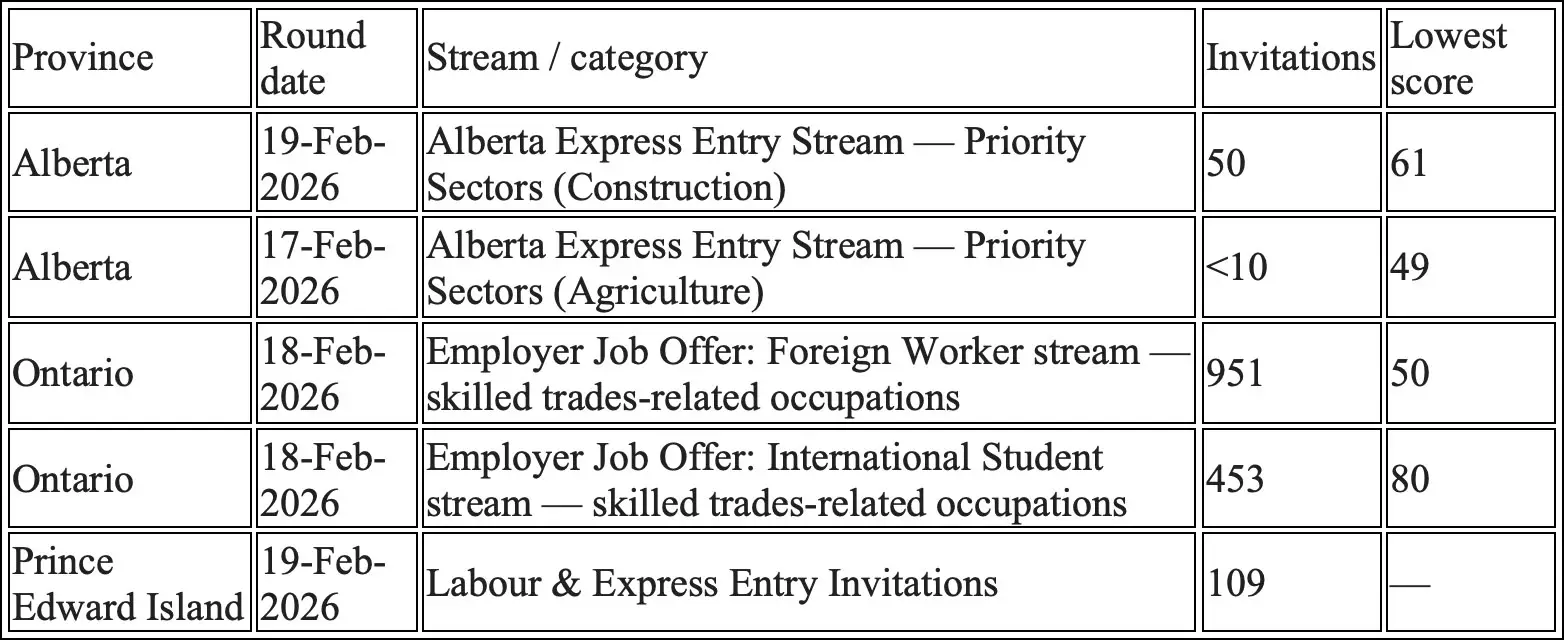
Provincial Nominee Programs
The content of this bulletin is for informational purposes only, and is not intended to provide or be relied on as legal advice.
For comprehensive legal analysis or strategic case support, contact Greenberg Hameed PC.
in**@*************ed.com
Click on the blurred section to reveal the full email address.
Suite 2079 – 325 Front Street West, Toronto, ON, M5V 2Y1
Business hours
Monday to Friday: 9 a.m. to 5 p.m.
Saturdays:
Sundays: Closed
View our full Privacy Policy.