

Explore the latest ImmPulse Weekly for key Canadian immigration insights—or browse past editions to catch up.
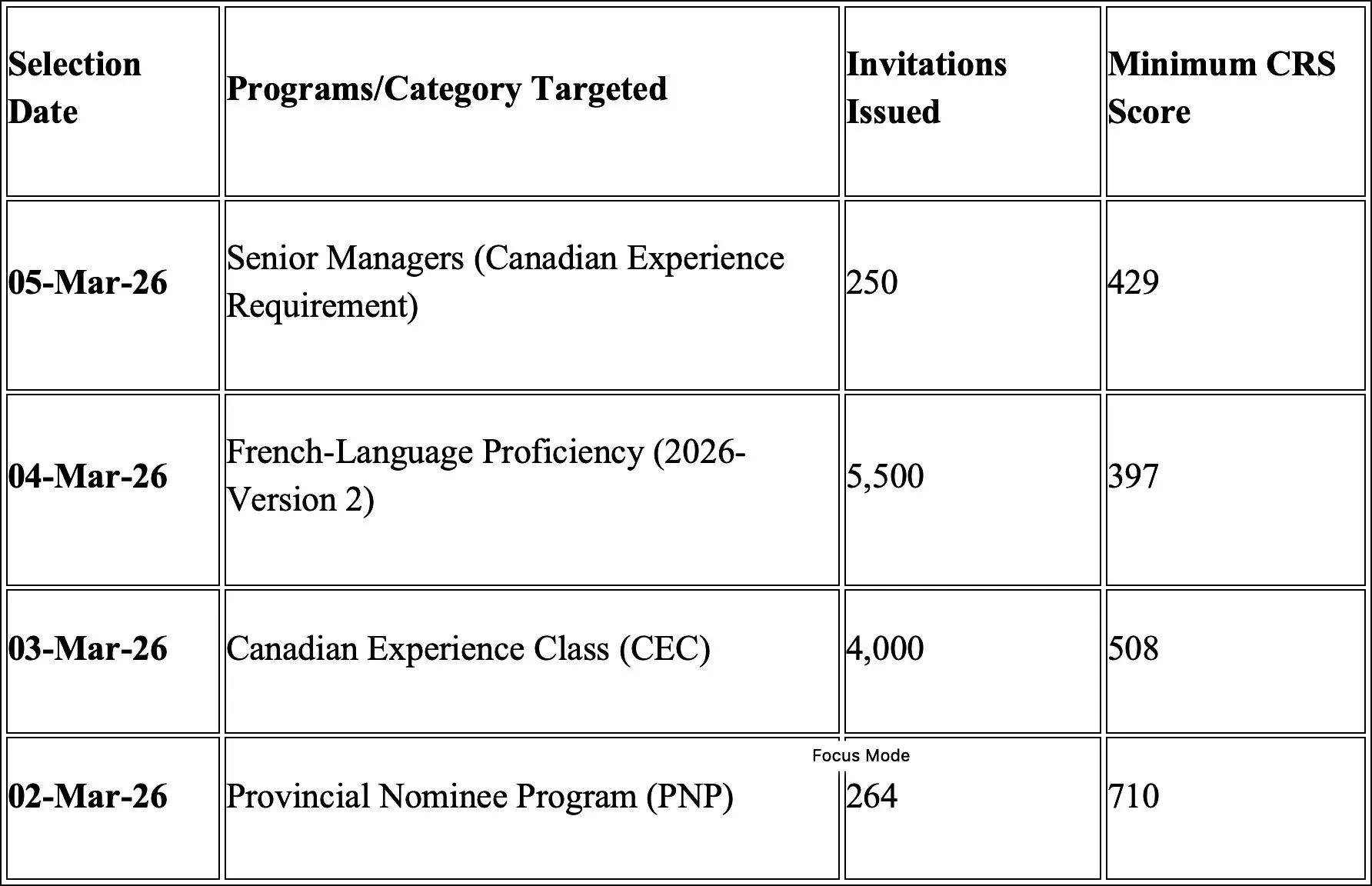
Express Entry:
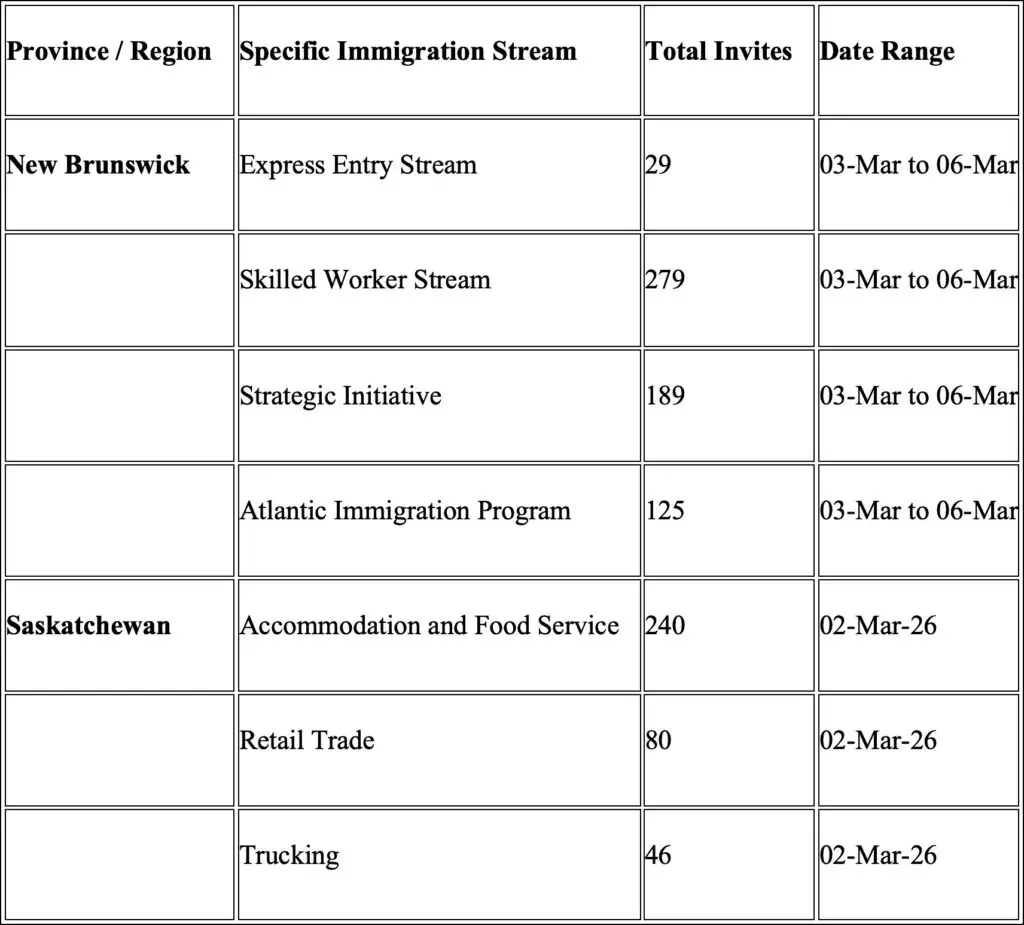
New Brunswick:
Saskatchewan
Immigration Minister Lena Metlege Diab has announced the soft-launch of a new program designed to grant permanent residency to 33,000 skilled temporary foreign workers in in-demand sectors over the next two years. This initiative arrives as Canada faces a significant surge in migrants losing their legal status, with nearly two million permits expected to expire in 2026 alone. The program aligns with Prime Minister Mark Carney’s broader mandate to reduce the non-permanent resident population to under 5% by 2027 while stabilizing permanent admissions and increasing Francophone immigration outside Quebec. Despite facing personal criticism regarding her visibility and competence, Diab emphasized that while extensions may be granted, those whose applications are rejected are expected to leave the country. Moving forward, the government plans to provide further clarity and specific data regarding the program’s progress in April 2026.
The Department of Justice has accused 430 immigration applicants of misrepresentation for allegedly using unauthorized “ghost agents” to file mandamus applications intended to speed up delayed visa processing. These cases were flagged because the court documents shared suspiciously similar phrasing, formatting, and contact information, even though the applicants claimed to be self-represented. While the government has moved to dismiss these cases to address a massive Federal Court backlog, which surged from roughly 7,800 cases in 2019 to over 24,000 in 2024, applicants argue they were driven to these agents by a lack of transparency and “unreasonably delayed” processing times. Many affected individuals, primarily Chinese nationals seeking study, work, or visitor permits, claim they were unfamiliar with Canadian law and only sought help out of desperation after official communication channels failed them. The Immigration Department continues to urge the use of authorized representatives and official resources to avoid such legal quagmires, while the targeted applicants contend the government should focus on the unauthorized agents rather than the victims of a “flawed” system.
The Government of Canada has announced that most passport and travel document fees will increase on March 31, 2026, to account for rising production costs and inflation. For applications made within Canada, the cost of a 10-year adult passport will rise to $163.50, a 5-year adult passport to $122.50, and a 5-year child passport to $58.50. Following this initial update, fees will be adjusted annually in accordance with the Service Fees Act. Additionally, to improve accountability, a new service standard starting April 1, 2026, mandates that complete passport applications be processed within 30 business days, or the applicant will automatically receive a full refund.
(Source)
Effective March 1, 2026, the Government of Canada has updated its special immigration measures for Iranian nationals to focus exclusively on those already in the country as workers. Eligible individuals who held a valid work permit issued on or before February 28, 2025, may apply for a one-time extension of up to two years, provided they have not previously utilized these specific special measures and maintain valid status throughout the application process. These measures are scheduled to expire on March 31, 2027, and require the payment of standard processing fees, including a $155 work permit fee and a $100 open work permit fee where applicable. Notably, Iranian nationals currently holding visitor records or study permits are no longer eligible for these special measures and must use regular IRCC processes to extend their stay.
(Source)
Effective March 4, 2026, IRCC updated the International Mobility Program (IMP) guidelines for spouses and common-law partners of study permit holders (category C42), clarifying that only those whose partners are enrolled in master’s programs of 16 months or longer, doctorate programs, or specific professional degree programs are eligible for an open work permit. Under these refined criteria, the principal foreign national must not be in their final term of study and must physically reside in Canada, while extension applicants are now subject to stricter requirements unless they fall under limited circumstances to align with an existing study authorization.
Officers must verify the genuineness of the relationship and ensure the applicant has sufficient independent funds, with standard processing including a $155 work permit fee and a $100 open work permit holder fee.
(Source)
As of March 5, 2026, Immigration, Refugees and Citizenship Canada (IRCC) has updated its operational guidelines for citizenship revocation, a critical tool for maintaining program integrity when citizenship is obtained through false representation, fraud, or knowingly concealing material facts. Under the current legal framework, the Federal Court serves as the default decision-maker for revocation cases, though individuals may request that the Minister make the final decision instead. The formal process begins with an initial investigation and a non-statutory request for information, followed by a formal notification letter that allows the individual 60 days to respond and present personal circumstances, such as the best interests of an affected child or potential statelessness, for consideration. Upon revocation, an individual’s status depends on the nature of the fraud; they may revert to being a permanent resident if the misrepresentation occurred only during the citizenship process, or become a foreign national if the fraud originated during their initial permanent residency application. Furthermore, anyone whose citizenship is revoked is prohibited from reapplying for a period of 10 years and is barred from seeking resumption of citizenship.
(Source)
On March 7, 2026, the Canada Border Services Agency (CBSA) announced an immediate Administrative Deferral of Removals (ADR) to Israel and Lebanon. This temporary halt is a response to volatile hostilities in the Middle East that pose generalized risks to civilian populations. While the ADR prevents the removal of most inadmissible individuals to these countries, it does not apply to those inadmissible on grounds of criminality, serious criminality, international or human rights violations, organized crime, or security. The CBSA currently maintains 16 such ADRs globally and will resume removals to Israel and Lebanon once the regional situation stabilizes. This announcement comes alongside high levels of enforcement activity, with the agency currently completing approximately 400 removals every week.
(Source)
On February 27, 2026, the Honourable Patty Hajdu announced a $1,304,500 FedNor investment in the Northern Policy Institute (NPI) to enhance workforce expansion and newcomer retention across Northern Ontario. A primary allocation of $959,500 will enable NPI to provide data analysis, advisory services for immigration pilots such as the Rural Community Immigration Pilot (RCIP), and develop a mobile app to assist newcomer integration. The remaining $345,000 is dedicated to identifying best practices in retention by surveying participants and employers involved in the Rural and Northern Immigration Pilot (RNIP) program. These initiatives are designed to equip regional municipalities with reliable evidence and strategic tools to measure the impact of population-focused programs and attract skilled talent.
(Source)
Effective March 2, 2026, the Manitoba Provincial Nominee Program (MPNP) has transitioned to a new inquiry process to streamline communications and improve response times. Under these updated guidelines:
(Source)
In recognition of Fraud Prevention Month in March, the Honourable Lena Metlege Diab, Minister of Immigration, Refugees and Citizenship, issued a statement highlighting the government’s commitment to safeguarding the integrity of Canada’s immigration system. The Minister urged the public to follow three essential steps: spot, stop, and report; identify warning signs such as guaranteed results or pressure for large cash payments; verify information through official channels; and report suspicious activity to the Canadian Anti-Fraud Centre. Reflecting on 2025, the government investigated over 95,000 fraud cases, introduced Bill C-12 to strengthen border security, and implemented penalties of up to $1.5 million for representatives who break the law. Moving into 2026, IRCC continues to advance legislative reforms to prevent the misuse of immigration documents and is increasing awareness messaging as Canada prepares to co-host the FIFA World Cup.
(Source)
Issue: Whether the Immigration Appeal Division (IAD) decision to dismiss a spousal sponsorship appeal was reasonable.
Facts: Mr. Alam, a Canadian citizen, sought to sponsor his new Pakistani wife. The IAD found the marriage was not genuine and was entered into primarily to acquire status under the IRPA. Concerns included discrepancies between Mr. Alam’s testimony and his application regarding the origin of the arranged marriage, limited knowledge of one another, and a lack of future planning .
Court Findings: The Court held that the IAD’s decision was reasonable. While arranged marriages are culturally accepted, they must still be based on some rationale or benefit if not based on love . The Court found the IAD reasonably weighed the evidence and identified discrepancies that undermined the Applicant’s credibility .
Outcome: Application for judicial review dismissed.
Why This Case is Important: It reinforces that in arranged marriage cases, applicants must still provide a “rationale” or evidence of compatibility to prove genuineness, despite cultural acceptance of the practice.
Issue: Whether the incompetence of an immigration consultant resulted in a breach of procedural fairness.
Facts: Mr. Green’s application for permanent residence was rejected as “incomplete” because his consultant accidentally submitted a second copy of his wife’s passport instead of his own . The consultant admitted full responsibility for the “inadvertence”.
Court Findings: The Court applied the three-branch test for ineffective assistance of counsel. It found that (1) failing to submit the correct passport was not an exercise of professional judgment but an “obvious and indisputable error” (incompetence); (2) there was a miscarriage of justice because the application would likely have been processed otherwise; and (3) notice was given to the consultant .
Outcome: Application for judicial review granted; the decision was set aside for redetermination.
Why This Case is Important: It clarifies that while litigants are generally bound by the actions of their representatives, this does not apply in cases of clear “incompetence” that result in a miscarriage of justice.
Issue: Whether an officer’s refusal of a C11 (entrepreneur) work permit was reasonable.
Facts: Mr. Hosseini, an Iranian citizen, applied for a work permit to operate a medical equipment business in Ontario . The officer denied the permit, citing a lack of evidence that the stay was temporary, a vague business plan, and inadequate English language skills for the role.
Court Findings: The Court found the decision reasonable. The officer correctly noted that a C11 permit requires evidence of temporary intent and “significant benefit to Canada” . The officer was justified in finding the $120,000 investment insufficient to prove significant benefit given the lack of a detailed staffing or job creation plan .
Outcome: Application for judicial review dismissed.
Why This Case is Important: It highlights that for “significant benefit” work permits (C11), a business plan must include specific details on job creation and regulatory compliance, and a substantial investment alone does not guarantee approval.
Issue: Whether an officer reasonably determined that an applicant lacked eligible work experience for the TR-to-PR Pathway.
Facts: Ms. Kaur applied for permanent residence as a “Social and Community Service Worker” (NOC 4212). However, during an interview, she stated that 80% of her duties involved stitching and embroidery (NOC 6342) and teaching prayer/music (NOC 4217), neither of which were eligible occupations .
Court Findings: The Court held the decision was reasonable. The officer was entitled to place significant weight on Ms. Kaur’s own interview statements over the subsequent legal submissions made by her counsel. The Court also ruled there was no breach of procedural fairness in the officer’s refusal to provide a transcript of the interview .
Outcome: Application for judicial review dismissed.
Why This Case is Important: It confirms that an officer’s contemporaneous interview notes (GCMS notes) are presumed accurate and can outweigh an employment letter when determining the “pith and substance” of an applicant’s work duties.
Issue: Whether the refusal of a Temporary Resident Visa (TRV) based on financial insufficiency was reasonable.
Facts: Mr. Khani, an Iranian national, sought to visit his sister in Montreal. The officer refused the visa because Mr. Khani’s bank statements showed “lump-sum deposits” and fluctuating low balances, suggesting the account was “inflated” for the application .
Court Findings: The Court found the decision reasonable. The officer correctly identified that the large deposits made immediately prior to the application were not explained by Mr. Khani’s salary. The officer’s duty to provide reasons for a TRV is “minimal” due to high processing volumes, and the financial finding alone was sufficient to refuse the visa.
Outcome: Application for judicial review dismissed.
Why This Case is Important: It emphasizes that TRV applicants must explain the source of funds, especially if there are large, recent deposits that do not align with their reported income.
Issue: Whether the refusal of a C11 (entrepreneur) work permit was reasonable.
Facts: Mr. Misaghi planned to start a machinery repair business in Edmonton. The officer denied the permit because Mr. Misaghi had limited experience running a business (his Iranian company was only 10 months old), his financial stability was questionable as he had liquidated assets to fund the startup, and the job creation plan for the first two years was not significant .
Court Findings: The Court upheld the decision. It was reasonable for the officer to focus on the “significant benefit” generated during the initial two-year permit period rather than speculative jobs created in year five . The officer also reasonably discounted a “support letter” from a Canadian business that did not evidence a signed contract.
Outcome: Application for judicial review dismissed.
Why This Case is Important: It establishes that for C11 permits, officers should prioritize the benefit generated during the term of the work permit rather than long-term future projections.
Issue: Whether an officer erred by failing to address a request for a Temporary Resident Permit (TRP) embedded in a permanent residence application.
Facts: Mr. Muhammad, who had lost his refugee status due to misrepresentation, applied for permanent residence on H&C grounds . His counsel’s 13-page submission ended with a single line: “[a]lternatively, a TRP is requested”. The officer refused the PR application but did not mention the TRP.
Court Findings: While the H&C refusal was reasonable, the Court found a reviewable error regarding the TRP. Following a long line of authority, the Court held there are no strict formal requirements for a TRP application, and even a single-line request in a letter triggers an officer’s duty to consider it.
Outcome: Application for judicial review granted in part (solely regarding the TRP request).
Why This Case is Important: It reaffirms that IRCC officers must address TRP requests even if they are briefly stated or embedded within larger applications.
Issue: Whether a finding of misrepresentation based on a fraudulent Letter of Acceptance (LOA) was reasonable and procedurally fair .
Facts: Mr. Ndigui applied for a study permit with an LOA from a Canadian university . IRCC verified with the school that the LOA was not issued by them. Mr. Ndigui received a procedural fairness letter but accidentally failed to hit “submit” on his online response.
Court Findings: The Court found the decision reasonable. Because the applicant failed to submit his response, the officer correctly decided the case based on the record, which included a “Verified – No Match” status from the university. The five-year ban for misrepresentation was a mandatory legal consequence, not a discretionary choice by the officer.
Outcome: Application for judicial review dismissed.
Why This Case is Important: It highlights the critical importance of the applicant’s responsibility to ensure documents are correctly submitted through the IRCC portal, as technical omissions by the applicant do not constitute an error by the officer.
Issue: Whether the Federal Court has jurisdiction to judicially review decisions made by a provincial nominee program (AAIP).
Facts: Two individuals, Mr. Patel and Ms. Kaur, sought judicial review of decisions by the Alberta Advantage Immigration Program (AAIP) to withdraw their provincial nominations.
Court Findings: The Court held it lacked jurisdiction. Under the Federal Courts Act, the Court only reviews “federal boards, commissions or other tribunals”. The AAIP is a provincial body established under Alberta law. Even though its decisions affect federal immigration applications, this does not “transform” it into a federal body.
Outcome: Applications for judicial review struck without leave to amend.
Why This Case is Important: It confirms that challenges to Provincial Nominee Program (PNP) nomination withdrawals must be brought in Provincial Superior Courts, not the Federal Court.
Issue: Whether the refusal of a TRV for a father seeking to visit his newborn son in Canada was reasonable.
Facts: Mr. Singh applied for a TRV to visit his wife (a student) and their baby born in Canada. The officer refused the visa, finding that Mr. Singh provided “insufficient evidence regarding the origin of the funds” in his bank accounts, which had doubled in size in just seven weeks.
Court Findings: The Court found the decision reasonable. It rejected the argument that the officer was required to consider “humanitarian and compassionate” grounds (like family unity with the newborn), noting that the TRV test under the Regulations is narrow and does not include an H&C analysis . The lack of a clear source for the funds was a valid, determinative reason for refusal.
Outcome: Application for judicial review dismissed.
Why This Case is Important: It clarifies that H&C factors (such as the “best interests of a child”) do not apply to standard TRV applications, which are strictly assessed on the applicant’s likelihood of leaving Canada.
Express Entry
Provincial Nominee Programs
The content of this bulletin is for informational purposes only, and is not intended to provide or be relied on as legal advice.
For comprehensive legal analysis or strategic case support, contact Greenberg Hameed PC.
in**@*************ed.com
Click on the blurred section to reveal the full email address.
Suite 2079 – 325 Front Street West, Toronto, ON, M5V 2Y1
Business hours
Monday to Friday: 9 a.m. to 5 p.m.
Saturdays:
Sundays: Closed
View our full Privacy Policy.